Wednesday, October 14. 2026
bigquery_fdw works again on every distribution we ship in the RPM repo
Monday, October 12. 2026
PostgreSQL RPM repository meets AI with pg_statviz
pg_statviz can now ask Claude, a local Ollama model, OpenAI or Gemini to explain your PostgreSQL statistics on every distro we ship it for. Getting there took three days and a few dozen new Python packages 
pg_statviz is a small tool that snapshots PostgreSQL's internal statistics and draws charts from them. Its newer releases also hand those numbers to an LLM and ask for an analysis. On Fedora this just worked, because Fedora ships fresh AI SDKs. On everything else, it did not -- until last weekend!
pg_statviz is a small tool that snapshots PostgreSQL's internal statistics and draws charts from them. Its newer releases also hand those numbers to an LLM and ask for an analysis. On Fedora this just worked, because Fedora ships fresh AI SDKs. On everything else, it did not -- until last weekend!
Monday, October 12. 2026
PostgreSQL RPM repository meets AI with pg_statviz
pg_statviz can now ask Claude, a local Ollama model, OpenAI or Gemini to explain your PostgreSQL statistics on every distro we ship it for. Getting there took three days and a few dozen new Python packages
pg_statviz is a small tool that snapshots PostgreSQL's internal statistics and draws charts from them. Its newer releases also hand those numbers to an LLM and ask for an analysis. On Fedora this just worked, because Fedora ships fresh AI SDKs. On everything else, it did not -- until last weekend!
pg_statviz is a small tool that snapshots PostgreSQL's internal statistics and draws charts from them. Its newer releases also hand those numbers to an LLM and ask for an analysis. On Fedora this just worked, because Fedora ships fresh AI SDKs. On everything else, it did not -- until last weekend!
Tuesday, September 29. 2026
Rust extensions started landing PostgreSQL RPM repository
Monday, September 28. 2026
Using the PGDG RPM repositories are now way easier!
Monday, September 28. 2026
RHEL / Rocky Linux / AlmaLinux repository RPMs now follow the OS minor version
Thursday, September 3. 2026
PostgreSQL RPM repo comes to Amazon Linux 2023!
If you run PostgreSQL on EC2, you've had two real choices until now: build from source, or fall back to whatever version Amazon Linux itself carries in its base repos. Neither matches what the rest of the PostgreSQL community gets from yum.postgresql.org — the full extension ecosystem, day-one minor releases, and a consistent layout across distributions.
That gap is closed. Amazon Linux 2023 is now a first-class target of the PGDG YUM repository, with its own build root and its own package tree, right next to Enterprise Linux, Fedora, and SUSE.
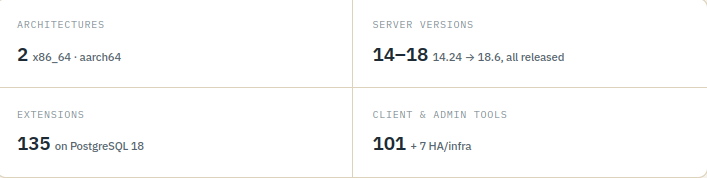
Summary first:
Monday, July 6. 2026
Inaugural PostgreSQL Istanbul Meetup was a blast!
Wednesday, March 25. 2026
Announcing openSUSE Leap 16.0 Support in the PostgreSQL RPM Repository
Monday, December 22. 2025
What happened?
Tuesday, February 27. 2024
Installing PostgreSQL on SLES 15 just got easier – and better!
Wednesday, November 16. 2022
Improved aarch64 (arm64) support is available in the PostgreSQL RPM repository.
Thursday, July 28. 2022
Pagila 3.0.0 is out with shiny new features and bugfixes
Wednesday, July 27. 2022
How to install PostgreSQL and PostGIS on Rocky Linux 9
Thursday, May 19. 2022
How to install PostgreSQL 14, 13, 12, 11 and 10 to Red Hat Enterprise Linux 9
About me
I am a PostgreSQL, Red Hat, and Fedora contributor working as Principal Systems Engineer at EDB
Maintaining the PostgreSQL YUM repository, PostgreSQL ZYPP repository, and maintain several packages in Fedora and EPEL.
Maintaining the PostgreSQL YUM repository, PostgreSQL ZYPP repository, and maintain several packages in Fedora and EPEL.
Quicksearch
Subscribe

Powered by
Subscribe
Blog Administration
Recent Entries
- bigquery_fdw works again on every distribution we ship in the RPM repo
- Wednesday, October 14 2026
- PostgreSQL RPM repository meets AI with pg_statviz
- Monday, October 12 2026
- PostgreSQL RPM repository meets AI with pg_statviz
- Monday, October 12 2026
- Rust extensions started landing PostgreSQL RPM repository
- Tuesday, September 29 2026
- Using the PGDG RPM repositories are now way easier!
- Monday, September 28 2026
- RHEL / Rocky Linux / AlmaLinux repository RPMs now follow the OS minor version
- Monday, September 28 2026
- PostgreSQL RPM repo comes to Amazon Linux 2023!
- Thursday, September 3 2026
- Inaugural PostgreSQL Istanbul Meetup was a blast!
- Monday, July 6 2026
- Announcing openSUSE Leap 16.0 Support in the PostgreSQL RPM Repository
- Wednesday, March 25 2026
- What happened?
- Monday, December 22 2025
Comments